

AR500 vs SR500 STEEL TARGETS:
THE REAL DIFFERENCE
If you’re investing in steel targets, the material matters more than anything else. Most targets on the market are made from AR500 steel. It’s widely available, cost-effective, and performs well for general use. But for shooters who demand higher durability, longer lifespan, and consistent performance under repeated impact, there’s another option:
SR500 steel.
This guide breaks down the real differences—without marketing fluff—so you can choose the right material for your training.
AR500 vs SR500: Side-by-Side Comparison
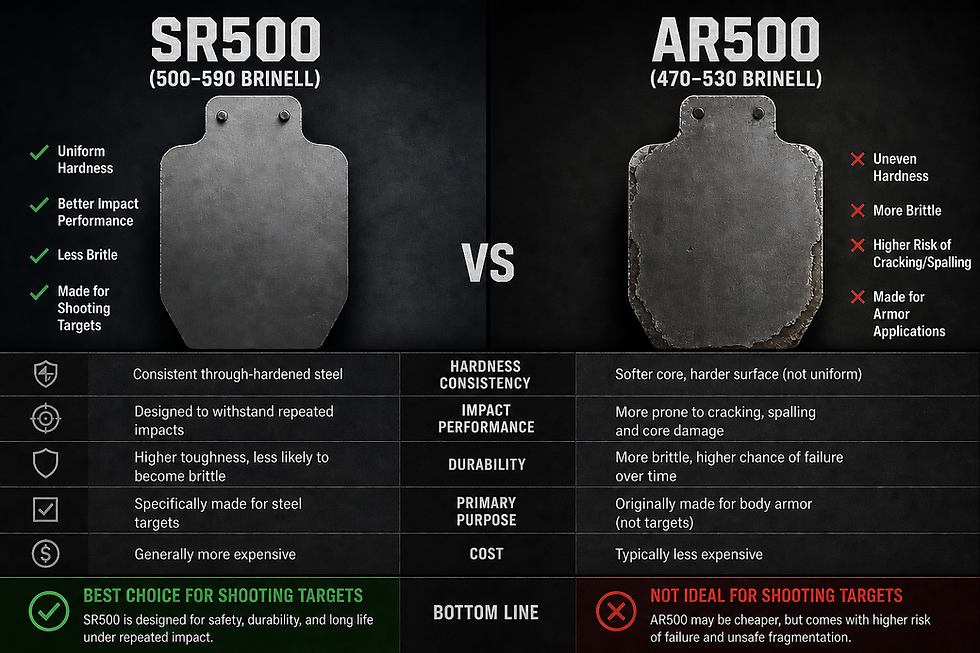
What Is AR500 Steel?
AR500 is a hardened steel commonly used for shooting targets. The “500” refers to its approximate hardness rating (Brinell hardness).
Why AR500 is popular:
-
Affordable and widely available
-
Performs well for most handgun and rifle applications
-
Industry standard for steel targets
Where AR500 starts to fall short:
-
Wears down faster under high-volume use
-
More susceptible to pitting and surface deformation over time
-
Shorter lifespan in demanding training environments
What Is SR500 Steel?
SR500 steel is a higher-performance hardened steel designed for increased durability and extended service life under repeated impact.
While less common in consumer-grade targets, it is engineered for more demanding use cases.
What sets SR500 apart:
-
Higher resistance to wear and deformation
-
Maintains a smoother surface longer
Better suited for repeated, high-volume shooting
What This Means in the Real World
With AR500:
-
You’ll get solid performance for general shooting
-
Over time, repeated impacts can create wear
-
You may replace targets sooner under heavy use
With SR500:
-
The surface holds up longer under repeated fire
-
Performance stays consistent over time
-
You spend less time replacing worn-out targets
For shooters who train frequently, this difference becomes obvious quickly.
Why Material Choice Matters for Training
Steel targets aren’t just about hitting something—they’re about feedback, consistency, and reliability.
When a target surface degrades:
-
Impact feedback becomes less consistent
-
Surface imperfections can affect performance
-
Safety considerations become more important
A higher-grade steel helps maintain:
-
Clean, predictable reactions
-
Reliable feedback
-
Longer usable life
Which One Should You Choose?
Choose AR500 if:
-
You shoot occasionally
-
You want a lower upfront cost
-
Your training volume is moderate
Choose SR500 if:
-
You train frequently or at high volume
-
You want longer-lasting equipment
-
You’re building a serious training setup
-
You care about long-term performance over upfront cost
Important Note on “Better”
SR500 isn’t about replacing AR500 entirely.
It’s about matching the material to the level of use.
For casual shooters, AR500 works.
For serious training environments, SR500 becomes the smarter long-term choice.
How This Applies to Reactive Target Systems
In dynamic training systems—where targets are:
-
Engaged repeatedly
-
Hit from multiple angles
-
Used in structured drills
Material durability matters even more.
That’s why systems like the Cyclone Tower™ are built using SR500—to maintain performance under real training conditions.
Bottom Line
AR500 is the standard.
SR500 is the upgrade.
If you’re investing in your training, your range, or your equipment, the material you choose will directly impact how long your targets last—and how well they perform over time.
Explore SR500 Target Systems
-
Cyclone Tower™ – Reactive Steel Target System
-
Impact Tower™ – Dynamic Training Target
-
Stepdown Tower™ – Multi-Plate Engagement System


