

Not all targets train you the same way.
Most traditional shooting targets are static:
-
You shoot once
-
The target absorbs the impact
-
Nothing changes
Reactive target systems are different.
They introduce:
-
Movement
-
Immediate visual feedback
-
Dynamic engagement
-
Faster target reacquisition
For shooters focused on improvement—not just punching holes—this difference matters.
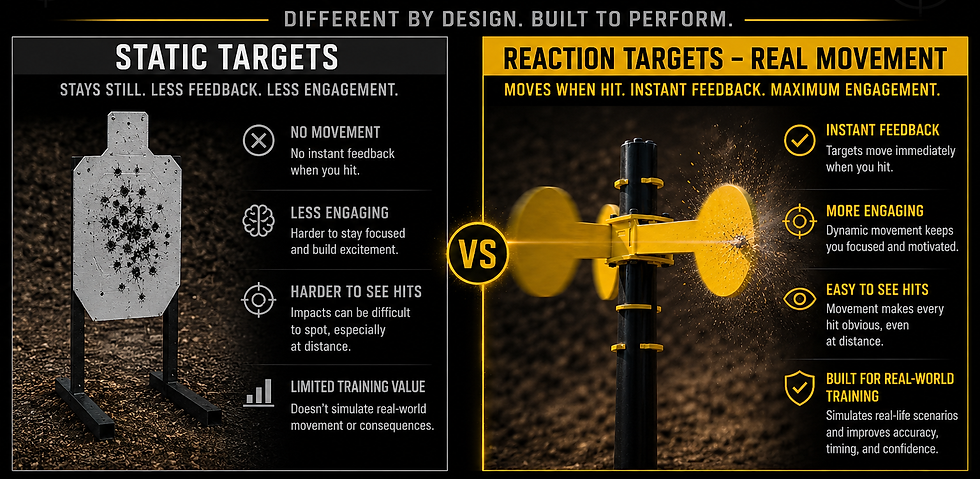
Reactive vs Static Targets: Which Improves Training More?

WHAT IS A STATIC TARGET?
Static targets remain fixed after impact.
Examples include:
-
Paper silhouettes
-
Cardboard targets
-
Fixed steel plates
They’re useful for:
-
Basic accuracy work
-
Zeroing optics
-
Slow-fire precision
But they provide limited engagement once the shot breaks.
Common limitations of static targets
-
Minimal feedback beyond the hit itself
-
No movement or reaction
-
Reduced engagement during long sessions
-
Less realistic target transition training
For many shooters, static targets become repetitive quickly.
WHAT IS A REACTIVE TARGET?
Reactive targets respond visibly when struck.
That response may include:
-
Motion
-
Swing
-
Rotation
-
Audible feedback
-
Multi-target movement
The result is a training experience that feels significantly more dynamic and engaging.
Why shooters prefer reactive systems
Immediate Feedback
You instantly see and hear successful impacts.
Movement Creates Challenge
The target response forces visual tracking and reacquisition.
Better Engagement
Reactive systems encourage longer, more focused practice sessions.
Improved Transition Training
Multi-target systems train rhythm, timing, and target-to-target movement.
WHY REACTIVE TARGETS FEEL DIFFERENT
Reactive targets create a loop:
-
Engage
-
Observe movement
-
Reacquire
-
Transition
-
Repeat
That cycle keeps shooters mentally and visually engaged in a way static systems often cannot.
REAL TRAINING BENEFITS
-
Faster visual processing
-
Better target transitions
-
Timing and rhythm
-
Recoil recovery awareness
-
Multi-target engagement skills
This is why reactive systems are increasingly used for:
-
Tactical training
-
Competitive shooting
-
Advanced range setups
-
High-volume practice environments
WHERE STATIC TARGETS STILL MAKE SENSE
Static targets still serve an important role.
They remain ideal for:
-
Benchrest shooting
-
Precision zeroing
-
Initial fundamentals
-
Low-cost practice
The goal isn’t to eliminate static targets.
It’s understanding when a reactive system delivers greater training value.
THE ADVANTAGE OF MODERN REACTIVE SYSTEMS
Older reactive systems often relied on:
-
Thin materials
-
Weak reset mechanisms
-
Simplistic movement
Modern systems—especially those built from hardened steel—introduce:
-
Greater durability
-
More reliable feedback
-
Multi-target interaction
-
Long-term training use
REACTIVE TOWER SYSTEMS
Built for Dynamic Training
The Cyclone Tower™, Impact Tower, and StepDown Tower Reactive Steel Target System were designed specifically to create:
-
Visible movement
-
Continuous engagement
-
Real-time feedback
-
Multi-target training flow
Unlike static plates, the Reactive Towers transform shooting into an active training experience.
FAQ SECTION
Are reactive targets better for training?
For many shooters, yes. Reactive targets increase engagement and provide immediate feedback that improves target transitions and shooting rhythm.
Are static targets still useful?
Absolutely. Static targets remain excellent for precision work, zeroing, and foundational drills.
Why do reactive targets feel more engaging?
Because movement and feedback create a more dynamic shooting experience that keeps shooters visually and mentally involved.
Do reactive targets improve target transitions?
Yes. Systems with multiple reactive elements help shooters train visual reacquisition and target-to-target movement more effectively.
TRAIN WITH FEEDBACK. TRAIN WITH PURPOSE.
Reactive targets don’t just absorb impacts—they respond to them.
That response changes the training experience completely.
